El Niño Is Strengthening in 2026: What Could It Mean for UK Households?
There’s been a fair bit in the news lately about El Niño, the warming pattern developing across the tropical Pacific Ocean. Some of the headlines have been striking: a potentially very strong event, changes to weather around the world, and warnings of wider disruption.
That might sound a bit dramatic when we’re looking at a map of the Pacific from a kitchen table in the UK.
The important point is that El Niño isn’t a forecast that a particular storm, flood or cold snap is heading for our town. It’s one large climate driver among several. It can change the odds of certain broad weather patterns, but the UK’s day-to-day weather still depends on the North Atlantic, the jet stream and plenty of other moving parts.
Even so, there’s a useful household lesson here. We don’t need to predict the next emergency to make a few ordinary preparations that help when weather, water or power services are disrupted.
What’s actually happened?
El Niño is the warm phase of a naturally occurring climate cycle called the El Niño–Southern Oscillation, or ENSO. During an El Niño, sea-surface temperatures across part of the central and eastern tropical Pacific remain warmer than usual. That warmth changes tropical rainfall and, in turn, can alter atmospheric circulation and weather patterns well beyond the Pacific.
The event now under way isn’t just speculation. In its 13 August 2026 update, NOAA’s Climate Prediction Center said El Niño had strengthened over the previous month. It put the chance of a very strong event during Northern Hemisphere autumn and winter 2026–27 at greater than 90%, with a 69% chance of an event of historic strength in October to December.
The Met Office has also said the developing event could become one of the most intense on record, although its eventual peak strength remains uncertain. The BBC’s clear explainer of the developing event is a useful companion to the official updates, particularly on why a warming Pacific can affect weather much further away.
That matters most directly to countries around the tropical Pacific. El Niño can alter the risk of drought, heavy rain, heat and tropical cyclones in different parts of the world. The effects aren’t uniform, and a stronger event doesn’t mean every place experiences its usual “El Niño weather”.
For us, the question is a narrower one: could it make a difficult UK weather season more likely?
What El Niño could mean for the UK
The honest answer is: it may influence the odds, but it can’t tell us exactly what will happen.
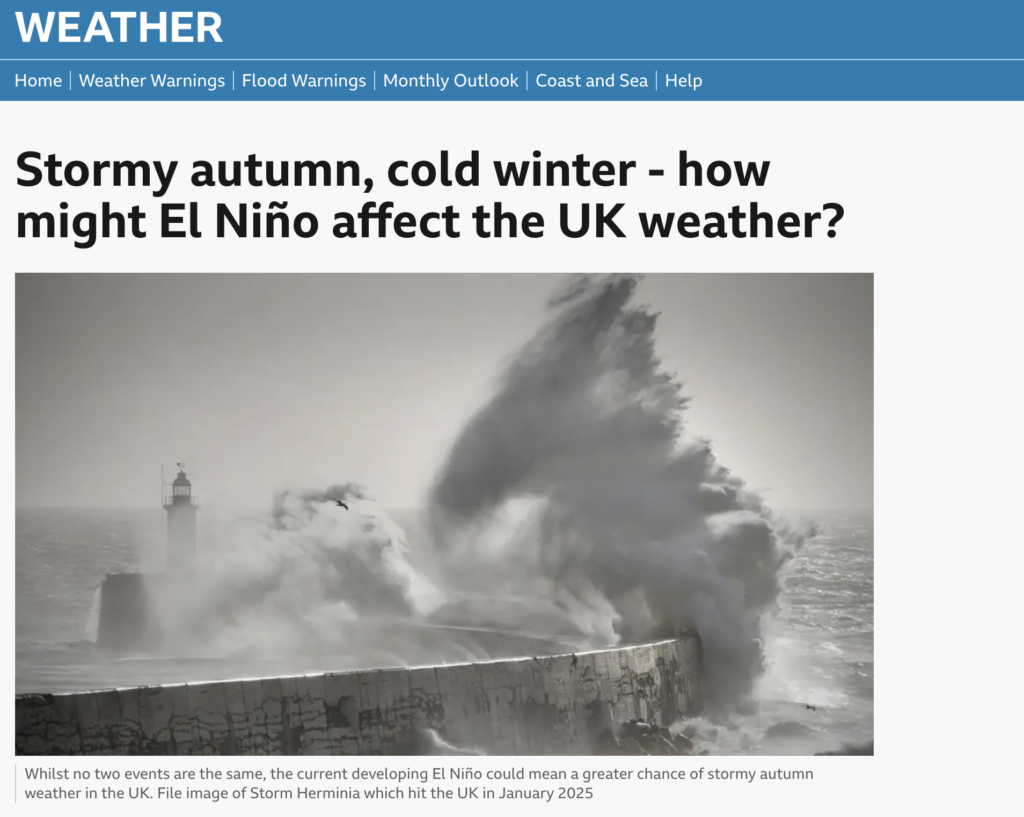
The Met Office says El Niño’s effects on Europe and the UK are typically indirect. In general, it can increase the likelihood of more unsettled conditions later in the year, including a milder, wetter and windier autumn and early winter. It can also be associated with colder, calmer periods later in winter. The BBC’s UK-specific overview reports that the Met Office is already seeing signals for increased rainfall and storminess in autumn, especially in November and December — but stresses that this isn’t guaranteed.
That might seem contradictory, but it’s a good illustration of why seasonal climate information needs care. “More likely” isn’t the same as “certain”, and broad signals over a season don’t replace an ordinary weather forecast for a particular week.
The North Atlantic Oscillation is especially important to our winter weather. In a positive phase, stronger westerly winds can bring relatively mild, wet and windy Atlantic weather. In a negative phase, winds are more likely to arrive from the north or east, bringing colder and often drier conditions — with snow possible in some situations. ENSO can influence these patterns, but it isn’t the only driver and the balance is uncertain, as the Met Office’s guide to climate drivers explains.
So it would be wrong to say, “El Niño means Britain will flood,” or, “El Niño means we are definitely getting a cold winter.” Both claims go far beyond the evidence.
It would be fairer to say this: a large El Niño is another reason to pay attention to official seasonal information as autumn approaches, and a useful prompt to check the unglamorous things that help a household cope with severe weather.
For many of us, that won’t mean starting from scratch or buying a great pile of new kit. If you’ve already got water, food, torches, power banks and a basic household plan, this is mainly a question of seasonal adjustments. Check that supplies are accessible, rotate what needs using, top up the everyday items that have run low and think through which problems are more likely in darker, colder and wetter months.
The aim isn’t to prepare for one exact forecast. It’s to make the preparations we already have fit the season ahead. If you’re still building the basics, why we’re being told to prepare for emergencies in 2026 is a useful place to start.
Don’t confuse El Niño with the summer we have just had
There’s another distinction worth making. The current dry, hot conditions in many parts of England shouldn’t simply be labelled “El Niño weather”.
In its 14 August update, the Environment Agency said 71% of England by land area was in drought. Reservoir storage was 65.9%, 13.8% below the long-term average for that point in the year, and more than 27 million people were subject to temporary water-use restrictions.
Those figures are serious, particularly for people affected by restrictions, low river flows, wildfire risk and pressure on local water supplies. But one climate pattern thousands of miles away isn’t a neat explanation for every hot or dry spell in the UK.
The wider, longer-term picture matters too. The Met Office says that, as average temperatures rise, UK heat extremes are becoming more frequent, longer-lasting and more intense. We can experience dry ground and a water shortage in one period, then face surface-water flooding when intense rain finally arrives. Dry, compacted ground often absorbs rain poorly.
The sensible response isn’t to try to diagnose every weather event at home. It’s to prepare for the ordinary knock-on effects: a water interruption, difficult travel, a power cut, an overheated home or a local flood warning.
Flood preparation is worth doing before a warning
Flooding is a good example of why basic preparation works best in advance. If a warning arrives at night, there isn’t much time to work out whether the house is at risk, find insurance details or look for a torch.
Start with the official tools. In England, the GOV.UK Check for flooding service shows current alerts and warnings, river and sea levels, and the flood risk for the following five days. It also directs readers to the equivalent services in Scotland, Wales and Northern Ireland. If your property is eligible, sign up for free warnings by text, phone or email.
This is useful even if you’ve never seen water in your home. Flood risk can come from rivers, the sea, groundwater, reservoirs or intense rain overwhelming drains and roads. Surface-water flooding is often very local, so it’s worth looking at information from the local council as well as the national service.
It’s also worth making a simple flood plan. GOV.UK suggests keeping it with essential items, medication, important documents and contact details. Ours doesn’t need to be a glossy folder. A sheet of paper or note on the phone can cover the essentials:
- Where will we go if we are asked to leave?
- Who needs help to get out safely, including neighbours, children, pets or relatives?
- Where are the water stopcock, gas shut-off valve and electricity main switch?
- What will we take: medicines, keys, chargers, documents, glasses, pet supplies and warm waterproof clothing?
- Who do we need to contact: family, insurer, landlord, school, utility company or employer?
Know where the main controls are, but only turn off gas, water or electricity if it’s safe to do so. Never touch electrical switches while standing in water.
If a flood warning is issued for your area and water is beginning to pool around the house, move early rather than waiting to see what happens. In a house, take photographs for insurance and move important documents, medication, electrical items and valuables upstairs if it’s safe. Lift furniture where you can too.
In a bungalow or single-storey home, get essential items as high as possible — onto worktops, high shelves or sturdy furniture. If you have safe access and enough warning, the attic can be a useful place to store possessions temporarily. It isn’t somewhere to shelter if floodwater rises: going into an attic can leave you trapped. Follow the emergency services’ advice and leave when asked.
This isn’t an abstract risk. In June 2025, intense thunderstorms caused flash flooding in Kent, with people evacuated or moved into temporary accommodation. The previous autumn, heavy rain in Shropshire closed roads and rail lines, with water flowing into homes in Gobowen. Flash flooding can develop quickly, which is why it’s worth deciding now what needs moving and where it can go.
Are sandbags useful?
Sandbags aren’t useless, but they are often treated as more of a solution than they really are.
They can help slow shallow water for a short period, particularly at low doorways or openings. They aren’t watertight, they are heavy, and water can still seep through or around them. We shouldn’t assume that the council will deliver them in an emergency either; local stocks may be prioritised for roads, emergency services and critical buildings.
If your property has a known, recurring flood risk, purpose-made removable barriers, door guards and air-brick covers may be worth investigating. Longer-term resilience measures can include non-return valves on drains, tiled or hard floors at ground level and raising sockets or electrical equipment higher up the wall.
The right option depends on the property and the type of flood risk. Anyone considering permanent work should take professional and insurer advice. Some measures are only suitable for relatively shallow water, and trying to keep deep water out can create structural problems.
Sandbags exposed to floodwater may be contaminated. Keep children and pets away from them, wear gloves when handling them and ask the local council about disposal. They shouldn’t go in ordinary household waste.
The priority during a flood is people, not possessions. Don’t walk, drive or swim through floodwater; it can hide holes, fast currents, open drains and contamination. If there’s immediate danger, call 999.
Don’t overlook cold-weather preparation
Flooding and storms are the obvious concerns when we hear “wet and windy autumn”, but cold weather belongs in the plan too. The link between El Niño and a cold UK spell later in winter isn’t strong enough to make a prediction. It is, however, enough of a reminder to check the basics before we need them.
If the temperature drops, a power cut or difficult journey can turn from inconvenient to genuinely uncomfortable quite quickly. We don’t need specialist winter-survival gear. A few ordinary checks can make a real difference:
- Find warm layers, hats, gloves, blankets and sleeping bags, and make sure they are dry and easy to reach.
- Check that torches, power banks and spare batteries are ready; cold, dark evenings are a bad time to discover a flat battery.
- Keep enough familiar food and drinking water at home to avoid an unnecessary trip to the shops during snow, ice or a local outage. The seven-day emergency food plan and three-day emergency water plan are useful refreshers.
- Know how your heating works and whether it depends on electricity for controls, ignition or pumps. If you use an alternative heating source, follow its safety instructions and never use equipment designed for outdoors inside the home.
- Check on anyone who might find a cold spell harder to manage, particularly older neighbours, people with health conditions and households with young children.
It’s also worth thinking about travel. Keep warm clothing, a phone cable and a torch in the car if you use one regularly, and give yourself permission to delay a non-essential journey when conditions are poor.
Build a small weather-disruption kit from things you’ll use anyway
Most of us don’t need a large, expensive “emergency kit”. A modest collection of useful everyday items is more realistic, easier to maintain and helpful for far more than a major weather event. Chances are, you already have much of it; this is a good time to make sure it is where you expect it to be.
A reasonable starting point is:
- A torch or head torch for each part of the house, with spare batteries or a charging plan.
- One or more charged power banks and the cables that fit our phones.
- A battery or wind-up radio if mobile and broadband networks are unreliable.
- A basic first-aid kit and any essential medication.
- A little cash and important numbers written down, not stored only on a phone.
- Warm layers, waterproofs, spare blankets and sturdy footwear.
- A small amount of food that can be eaten without refrigeration or much cooking.
- Drinking water, plus what babies, pets and medical needs require.
There’s no need to buy all of this at once. My three-day emergency water plan explains how to build and rotate a manageable water supply, while the seven-day emergency food plan focuses on normal cupboard food rather than specialist rations.
If a storm causes a power cut, the basic rules are very similar. Keep torches and charging options accessible, rather than relying on the torch in a phone. Make sure power banks are charged. Think about which food can be eaten cold if the cooker, microwave or fridge are unavailable. My power-cut preparedness guide and short-term power-backup options might help with the practical choices.
An emergency box isn’t much use when it’s in a dark loft behind Christmas decorations. Keep the essentials accessible and let everyone in the household know where they are.
Think about people, not just equipment
Weather disruption is harder when someone needs medication, relies on electric medical equipment, has reduced mobility, cares for a baby or has a pet that can’t simply be left behind.
Make sure medication lists and prescriptions are up to date. Keep any necessary baby supplies and pet food in the plan. If someone in the household could need additional help during a water or power outage, check whether they are eligible for their supplier’s Priority Services Register.
It’s worth having a quiet conversation with neighbours too. This doesn’t mean taking responsibility for everyone on the street. It might just mean knowing whether an older neighbour has family nearby, agreeing to exchange phone numbers, or checking in after a serious warning has passed.
A simple starting point this weekend
El Niño is a useful reason to check our preps, not a reason to panic buy or forecast a crisis.
If you haven’t done anything yet, start with these five actions:
- Check the long-term flood risk for your postcode and sign up for warnings if available.
- Find the stopcock, consumer unit and gas shut-off valve; make sure other adults in the home know where they are too.
- Charge a power bank and place a working torch somewhere easy to reach.
- Put essential documents, medication details and key contact numbers together.
- Add a little extra water and a few familiar, no-cook foods to the next shop.
That won’t make us immune to bad weather. It will give us some breathing room while forecasts update, roads reopen or services recover.
We can’t control the Pacific Ocean, the jet stream or the next spell of rain. We can make sure an inconvenient few days don’t immediately become a household crisis.
A little disclosure: there are affiliate links on this website! That just means if you click on a link, find something you like and buy it, this site might receive financial benefit. Don’t worry, you won’t pay any extra – sometimes you might even get a discount. These links help to pay for the upkeep of the site.
Disclaimer: The content of this website is opinion and should never be considered as professional advice. Always consult a professional in the relevant areas.