Could Britain Face Food Shortages? What the 2026 Harvest Means for Our Food Supply.
After one of the hottest and driest summers we’ve experienced, food security is starting to appear in the news again.
We have just recorded our hottest summer on record. According to the Met Office, the average UK temperature across June, July and August reached 16.5°C, beating the previous record set only last year. For many parts of the country it was also exceptionally dry, and those conditions have had consequences for farming, water supplies and the countryside.
England is still dealing with drought despite the return of more unsettled weather. Farmers have faced difficult growing and harvesting conditions, concerns remain over livestock feed for the winter, and some crops have produced disappointing yields. Earlier in the summer, the dry ground and vegetation also contributed to increased field fires and a much wider wildfire problem.
At the same time, El Niño is strengthening, food manufacturers are warning that prices could begin climbing more quickly again, and extreme weather continues to affect food production well beyond Britain.
There’s no current evidence that we’re heading towards a widespread national food shortage. Our food supply is supported by domestic farming, large supermarket distribution networks and imports from across Europe and the rest of the world. However, the events of this year show how many different things have to work together for the food we want to remain readily available and affordable.
We can’t control harvests, international shipping or the weather, but we can give ourselves a little more flexibility at home.
The drought has already affected this year’s harvest
The effects of this year’s dry weather have been visible for months.
By July, some farmers were harvesting unusually early. The Environment Agency reported reduced crop yields, livestock farmers dipping into winter forage reserves during the summer, an early end to the British salad season and more fires during harvesting because crops and surrounding ground were so dry. At one point, July was on track to become England’s driest on record.
Later assessments showed just how variable the harvest had become. Wheat and spring barley yields were reported below their five-year national averages, while farmers continued to worry about whether there would be enough fodder available for livestock through the winter. The Environment Agency’s late-August and early-September assessment gives more detail.
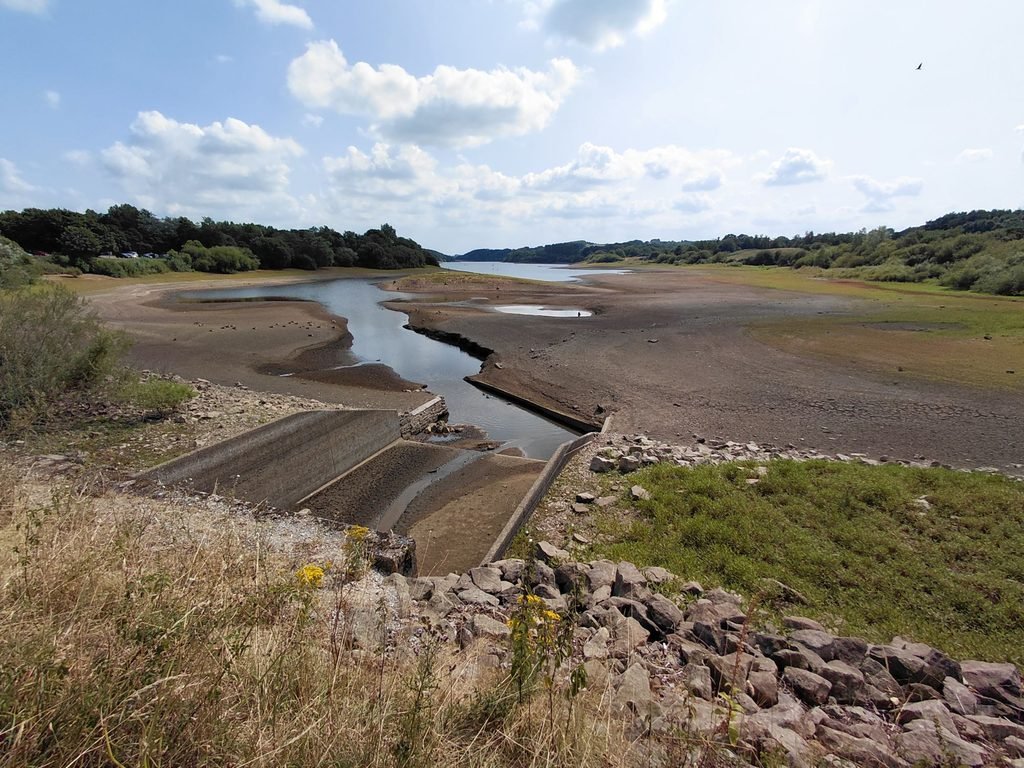
Rain has finally returned to many areas, but the underlying water position remains poor. As of the 10th of September, ten Environment Agency areas were still officially in drought. National reservoir storage stood at 56.9%, almost 20% below the level normally expected at this point in the year, and temporary water-use restrictions were still affecting around 30 million people. The latest official drought summary still described the overall water-resource position as poor.
Those same conditions have also contributed to another difficult year for wildfires. During July, the Environment Agency reported wildfires occurring around the country alongside an increase in fires during harvesting. Dry grass, crops and moorland can allow a relatively small ignition to spread much more quickly.
I looked at that wider issue earlier this summer in Are We Taking the UK’s Wildfire Risk Seriously Enough? Food production, water availability and wildfire risk are closely connected. A prolonged spell of hot, dry weather can put pressure on all three at once.
We already import a large share of our food
We still produce a significant amount of what we eat, although our dependence on overseas food has increased considerably over the longer term.
Defra estimates that our food production-to-supply ratio was around 60% in 2025, down from 65% the year before. For foods that can readily be produced in this country, the figure was around 72%.
The longer-term comparison is more interesting. During the 1980s, our overall production-to-supply ratio was above 80%. It subsequently declined and has spent much of the past decade hovering around 60%.
That figure shouldn’t be read as a literal measurement of how much of every meal was grown here. Defra calculates it using the value of agricultural production and food supply. It does, however, give us a useful indication of how the balance between domestic production and imports has changed.
We also produce some foods far more successfully than others. Milk, meat and many cereal crops have relatively high levels of domestic production. Fresh produce is much more dependent on imports. In 2025, our farms produced the equivalent of around 56% of fresh vegetable supply and only 14% of fresh fruit. Tomatoes were particularly dependent on overseas production, with domestic output equivalent to around 17% of supply.
Imports have obvious advantages. A disappointing British harvest can be offset by buying more food from countries enjoying better growing conditions. The difficulty comes when several pressures overlap. Drought here matters more if European producers are also struggling. Poor harvests overseas matter more if shipping, energy or fertiliser costs are rising at the same time.
That interdependence is part of the reason the Government’s UK Food Security Report considers both strong domestic agriculture and diverse international supply chains important.
El Niño adds another uncertainty
The developing El Niño matters because so much of our food supply extends beyond our own borders.
The World Meteorological Organisation expects El Niño conditions to strengthen further through the autumn, with the event intensifying towards November and December.
El Niño can change rainfall and temperature patterns across large parts of the world. Some important agricultural regions can become drier, while others experience unusually heavy rainfall. The effects vary considerably between countries and between individual El Niño events.
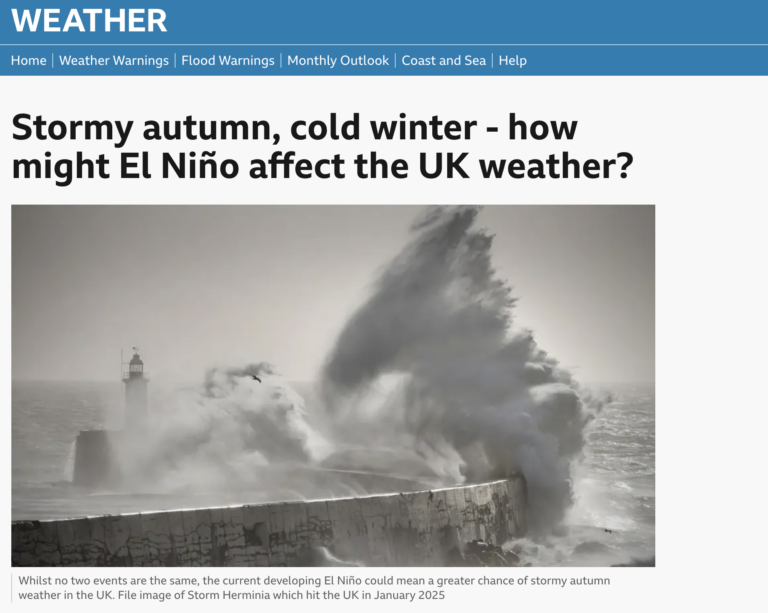
We also shouldn’t simply blame Britain’s hot summer on El Niño. The connection between El Niño and our own weather is much less direct, something I’ve looked at separately in El Niño Is Strengthening in 2026: What Could It Mean for UK Households?
The food-supply consequences can be easier to understand. If a country producing grain, fruit, vegetables, animal feed or vegetable oils has a poor harvest, international prices can rise. If several large producing areas experience problems during the same season, buyers around the world may find themselves competing for the same supplies.
The Food and Drink Federation is already including drought and El Niño among the pressures it expects to push our food prices higher. Its September forecast suggests food inflation could reach 3.9% by December, before potentially peaking at 6.4% during the summer of 2027. Energy, transport, ingredients, packaging and geopolitical disruption are also feeding into that forecast.
For now, food inflation remains comparatively subdued. The latest Office for National Statistics figures showed food and non-alcoholic drink prices 1.3% higher in July than a year earlier.
Food is therefore still getting more expensive year on year, even though the current rate of increase is much lower than it was during the recent cost-of-living crisis. The concern is what happens next.
Could we actually face food shortages?
A widespread shortage of food across Britain currently looks unlikely.
Our supermarkets can switch suppliers, source produce internationally and substitute one product for another. A poor wheat harvest in Britain doesn’t automatically translate into a shortage of bread, just as a poor British tomato crop doesn’t mean tomatoes disappear from supermarkets.
Individual products could become temporarily harder to find, though. Prices can also change substantially even when supply remains available.
We’ve seen how quickly supermarket availability can change when buying behaviour suddenly shifts.
During the early stages of COVID, products including flour, pasta, rice and UHT milk disappeared from shelves and supermarkets introduced temporary purchase limits. Food was still moving through the supply chain, but retailers struggled to replenish shops at the same rate customers were removing products.
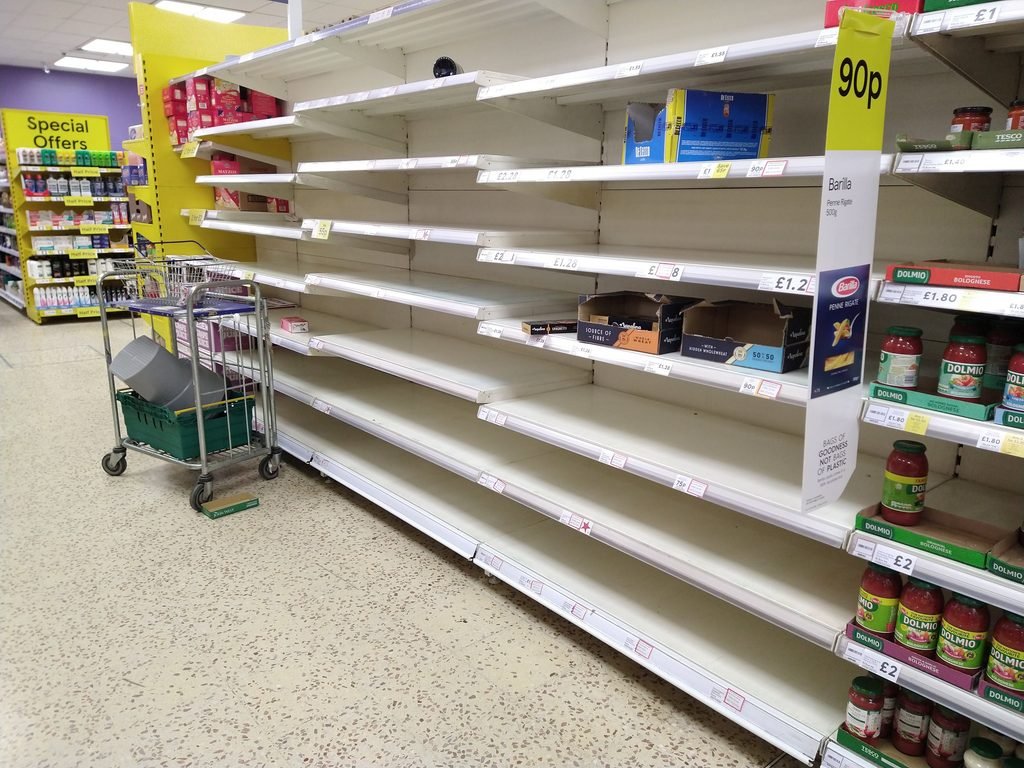
The Government’s later household food-security analysis also records the substantial changes in shopping behaviour during the pandemic.
A supermarket supply chain is extraordinarily efficient. It also relies heavily on fairly predictable demand. Someone who already has a reasonable supply of everyday food at home has far less reason to rush to the shops because other people have started doing so.
We could keep a little more food at home
Frequent food shopping has become incredibly convenient.
I’m a good example. I have three supermarkets within around 500 metres of home. If I run out of milk, bread, pasta or almost anything else, replacing it normally involves a walk of a few minutes.
It’s easy to see how that changes our habits. When food is always close by, there isn’t much incentive to keep several weeks of everyday staples at home. Online shopping and rapid delivery services have made that dependence on the next shop even easier.
Keeping an additional week or two of foods we already eat gives us some breathing room. Those foods can still move through the normal household rotation, with older products used first and replacements added during ordinary shopping.
There can be a financial benefit too. Buying larger quantities of long-life foods when the price is genuinely better can reduce the cost per meal as well as increasing what we have at home. Rice, pasta, tinned foods, cereal, UHT milk, cooking ingredients and household staples are all examples where larger packs or sensible multi-buy offers may work well for some households.
We still need to check the numbers. The Competition and Markets Authority has examined unit pricing because larger packs and promotional offers aren’t automatically cheaper. Comparing the cost per kilogram, litre or individual item is a much better way of working out whether a bulk purchase is actually saving anything.
There’s little benefit in buying a large quantity of something we won’t use before its quality deteriorates either. For most households, gradually increasing the amount of normal food already passing through the kitchen will be easier to manage than buying a separate emergency stockpile.
My 72-Hour Food Preparedness guide covers the shorter end of this, while the 7-Day Emergency Food Plan looks at building a more substantial supply from familiar cupboard foods.
Growing food at home used to be much more normal
Producing at least some of our own food can add another layer of resilience.
The idea is hardly new. Britain’s gardens and allotments became an important part of the national food supply during and immediately after the Second World War.
At the outbreak of war, Britain was heavily dependent on imported food and vulnerable shipping routes. The Government’s Dig for Victory campaign encouraged people to use gardens, allotments and spare pieces of land for food production. Parks, sports grounds and other public spaces were converted for growing. The National Archives preserves examples of the wartime campaign and its propaganda.
By 1943, the Royal Horticultural Society records that Britain had around 3.5 million allotments producing more than a million tonnes of vegetables. The effort continued beyond the end of the war, with rationing remaining in place until 1954. The RHS archive has a useful account of the gardening effort.
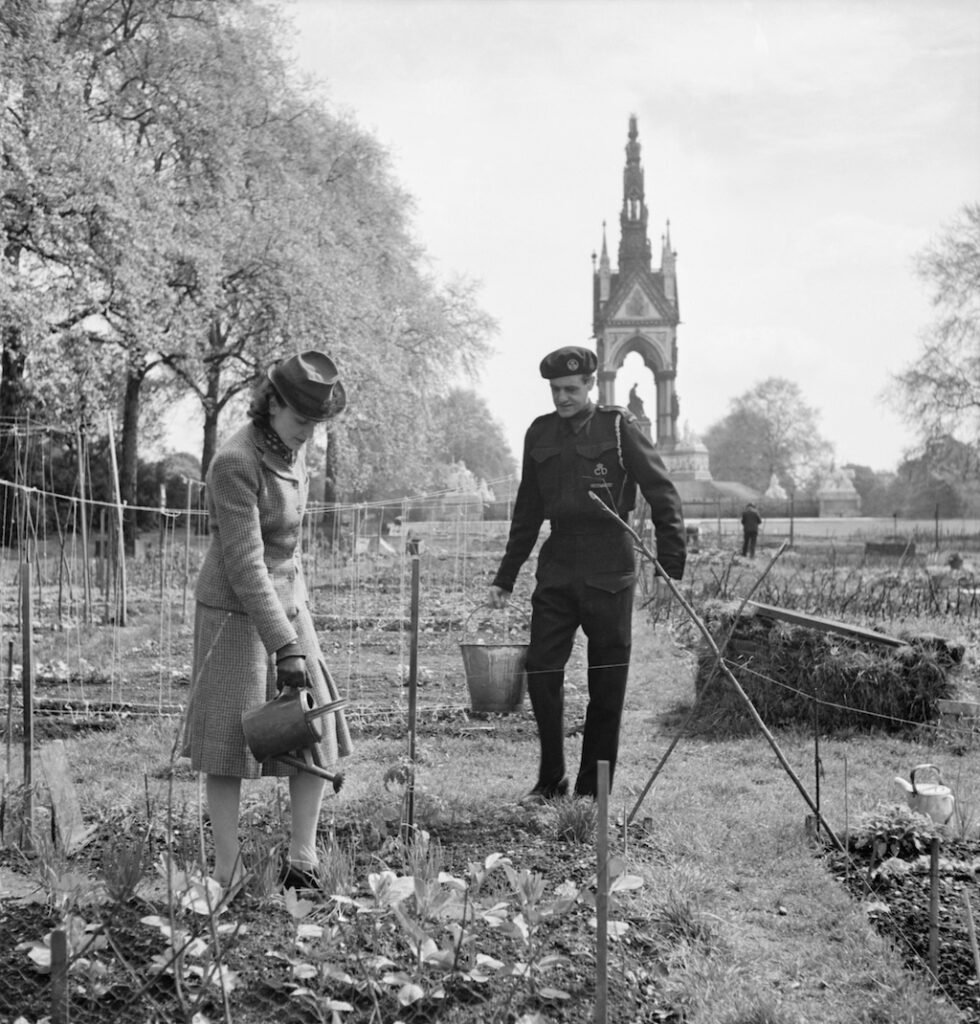
Our circumstances today are completely different, but the period demonstrates just how much food can be produced surprisingly close to home.
We don’t all need an allotment. Herbs, salad leaves, tomatoes, beans, courgettes, potatoes, chillies and soft fruit can be produced in ordinary gardens. Many will also grow in containers where space is limited.
The Royal Horticultural Society, usually shortened to the RHS, is Britain’s major gardening charity and one of the country’s best-known sources of practical horticultural advice. Its guidance on growing vegetables in containers is particularly useful for households without space for a traditional vegetable plot.
The economics will vary. Some crops are cheap enough in the supermarket that growing them purely to save money might be difficult to justify. Others can provide repeated harvests from a fairly small area. Fresh herbs, salad leaves, tomatoes, chillies and soft fruit are particularly interesting because supermarket prices can add up over a season while productive plants can keep providing food for weeks or months.
Experience matters as much as the crop itself. Growing successfully involves learning what works in our own soil, garden and local climate. That takes time. The best time to learn how to grow food is while we don’t desperately need the harvest.
A kit greenhouse can make a small growing area much more useful
Protected growing can extend what we’re able to produce considerably.
A greenhouse doesn’t have to mean an expensive traditional glass structure. Flat-packed aluminium and polycarbonate greenhouses, polytunnels, growhouses, cold frames and mini-greenhouses are widely available in sizes suitable for everything from a small patio to a larger garden.
Even a relatively modest structure can extend the growing season.
The RHS says an unheated greenhouse can be used to start hardy vegetables earlier, obtain earlier harvests and grow tender crops including tomatoes, peppers, chillies, cucumbers and aubergines. Later in the year, that same space can be used for salads and other cooler-season crops.
With some planning, a greenhouse can contribute to food production during much of the year. Winter might involve hardy salads, herbs or overwintering plants rather than trying to produce tomatoes in January.
Heated greenhouses can be used more extensively through winter, although the RHS points out that continuously heating one for year-round production is rarely economical. That matters if reducing food costs is one of our aims. Spending a large amount on electricity to grow a few winter tomatoes is unlikely to help the household budget.
An inexpensive kit greenhouse used intelligently across several seasons is a more interesting proposition. We can start plants earlier in spring, grow higher-value tender crops through summer and continue harvesting suitable crops later into autumn or winter.
It also gives us the opportunity to produce more of some foods where Britain currently depends heavily on imports. Tomatoes are an obvious example given that domestic production currently accounts for only a relatively small proportion of our supply.
A greenhouse won’t replace the weekly shop, but it can reduce how often we need to buy certain fresh foods while providing useful growing experience at the same time.
Growing more food means thinking about water too
This year’s drought is a reminder that increasing food production at home can increase our demand for water.
Fortunately, adding rainwater storage to a garden can be fairly straightforward. A basic water butt connected to a house, garage, shed or greenhouse downpipe can collect a useful amount whenever it rains. If one fills regularly, adding another one or two alongside it is normally simple and relatively inexpensive. The RHS specifically recommends linking multiple water butts where more capacity is needed.
Compared with many household resilience measures, a water butt is also inexpensive. Once installed, the rain falling on the roof is available for the garden rather than being sent straight into a drain. Waterwise has been encouraging households to install water butts in advance of dry periods for much the same reason.
I already use a garden water butt as part of my own preparations, something I’ve covered in How I Prep: Water Shortage Preparedness. Adding another butt or two would be one of the easiest ways for me to increase that capacity if I started growing more food.
It’s worth keeping garden water and drinking water separate in our planning. Untreated water collected from a roof shouldn’t simply be assumed to be safe to drink.
For household drinking and emergency storage, my UK Emergency Water Storage Calculator can estimate requirements based on household size, pets and the amount already stored. The 3-Day Emergency Water Plan goes into the basics in more detail.
Food resilience starts long before a shortage
This has been a difficult growing year, and the combination of drought, wildfires, a developing El Niño and continued pressure on international supply chains gives us good reason to pay attention to where our food comes from.
Keeping a little more of the food we already use gives us more flexibility. Buying long-life staples in larger quantities when the unit price makes sense can reduce costs while gradually deepening our stores.
Growing a few crops can take that a step further. A vegetable bed, some containers or a relatively inexpensive kit greenhouse can supply part of our fresh food for months at a time. Preserving, freezing or storing anything produced in excess can extend the value of that harvest further.
None of us knows exactly what food prices or harvests will look like several years from now. Recent history suggests that assuming everything will always remain cheap and immediately available probably isn’t the best household plan either.
Most of us will continue buying the majority of our food from supermarkets. I certainly will.
Having enough at home to miss the next shopping trip, take advantage of a good bulk price, or manage for a while when a familiar product becomes difficult to find gives us options.
Producing even a small amount ourselves gives us a few more.
After the weather and growing conditions we’ve experienced this year, that extra margin feels increasingly worthwhile.
A little disclosure: there are affiliate links on this website! That just means if you click on a link, find something you like and buy it, this site might receive financial benefit. Don’t worry, you won’t pay any extra – sometimes you might even get a discount. These links help to pay for the upkeep of the site.
Disclaimer: The content of this website is opinion and should never be considered as professional advice. Always consult a professional in the relevant areas.