Are We Taking the UK’s Wildfire Risk Seriously Enough?
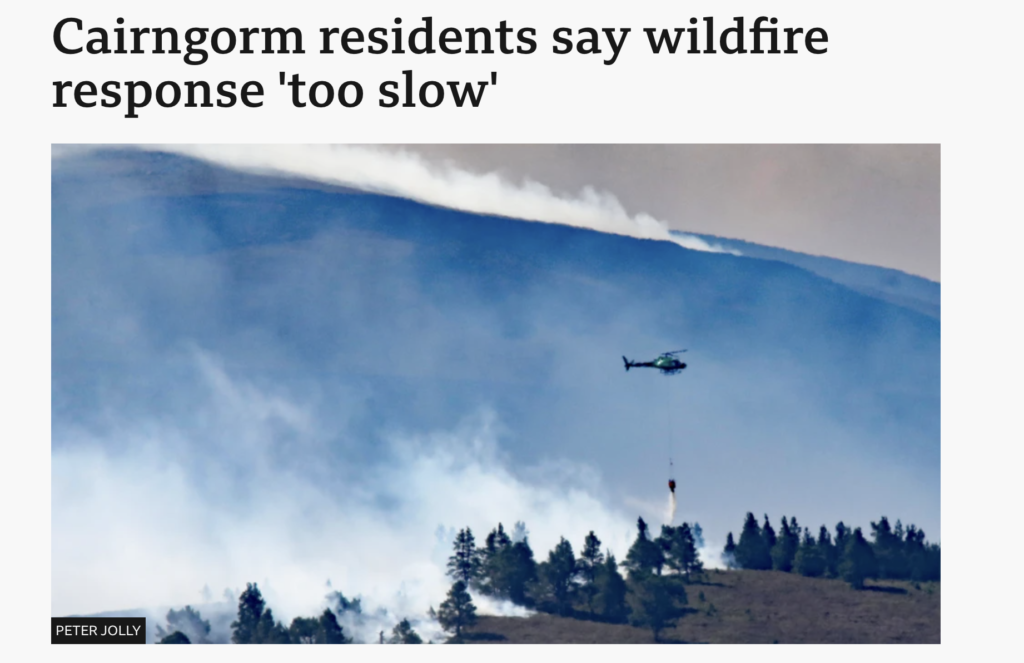
Wildfires still feel like something we associate with southern Europe, Australia or California. We see aircraft filling up from the sea, helicopters carrying large buckets of water and whole communities being evacuated.
It’s easy to assume that fires here are smaller and easier to deal with.
That’s becoming harder to believe.
We’ve seen serious fires across England, Scotland and Wales over the last few years, often affecting moorland, farmland, forestry and areas that are difficult to reach with normal fire engines. Some have burned for days, involved hundreds of firefighters and required support from landowners, contractors and the military.
The figures move around considerably from one year to the next, but the general direction is worrying. The National Fire Chiefs Council said fire and rescue services in England and Wales had attended 856 wildfires by 12 August 2025.
By the end of July, the number was 33% higher than during the same period in 2022, which had previously been treated as a record year. It was also 663% higher than the equivalent period in 2024.
Government reporting later found that wildfires had burned more than 47,500 hectares across the UK by August 2025.
This doesn’t mean we suddenly need a large fleet of specialist water-bombing aircraft. Our climate, geography and fire season aren’t the same as those in Greece, Spain or southern France.
It does mean we should probably ask whether our present system is still suitable.
Most fires still need somebody to start them
Heatwaves and dry weather don’t usually start wildfires by themselves. They dry out grass, heather, peat and woodland litter, allowing a discarded cigarette, barbecue or small flame to spread far more quickly than it normally would.
Wind then makes the situation worse, particularly across open moorland where the fire can move faster than crews can contain it.
Many UK wildfires are linked to human activity, whether careless or deliberate.
Disposable barbecues are a recurring example. They’re often placed directly onto grass, remain hot long after they appear to have gone out and may be abandoned before they’re properly cold.
The National Fire Chiefs Council’s public advice tells people to avoid disposable barbecues in open countryside, parks and moorland during dangerous conditions. Fire services also regularly warn about cigarettes, matches and campfires being used around dry vegetation.
There’s a reasonable argument for stronger restrictions on disposable barbecues when the fire risk is very high. Some councils, parks and retailers already impose local restrictions, but the approach is inconsistent.
Arson is another part of the problem. Deliberate fires have been suspected or confirmed during a number of recent incidents.
It’s difficult to prevent every determined individual from starting a fire, but better patrols, early detection and a visible response to suspicious behaviour may stop a small incident becoming a major one.
Agricultural machinery, vehicles, electrical faults and controlled burns that escape can also provide an ignition source. That’s why prevention can’t be reduced to telling walkers not to light barbecues.
Land management, access routes and the condition of dry vegetation all influence how far a fire spreads once it starts.
Solar farms sometimes appear in the discussion as well.
Solar panels, cables, connectors, inverters and transformers can catch fire, just like other electrical equipment. A fault could potentially ignite dry vegetation beneath or around an installation.
That doesn’t mean solar farms are a major cause of UK wildfires. There’s little evidence to suggest they are.
The more realistic concern is whether vegetation is being properly managed, whether fire engines can reach the site and whether responders have clear information about electrical isolation points. A well-maintained solar farm with managed grass and suitable access is very different from a poorly maintained site surrounded by dry vegetation.
The government has previously commissioned research into fires involving photovoltaic systems, although this covered a range of rooftop and commercial installations rather than showing that solar farms are driving wildfire numbers.
Prevention matters, but it won’t stop every fire. We also need to consider what happens once a fire has reached difficult terrain and is spreading beyond the resources immediately available.
The helicopters exist, but access to them is limited
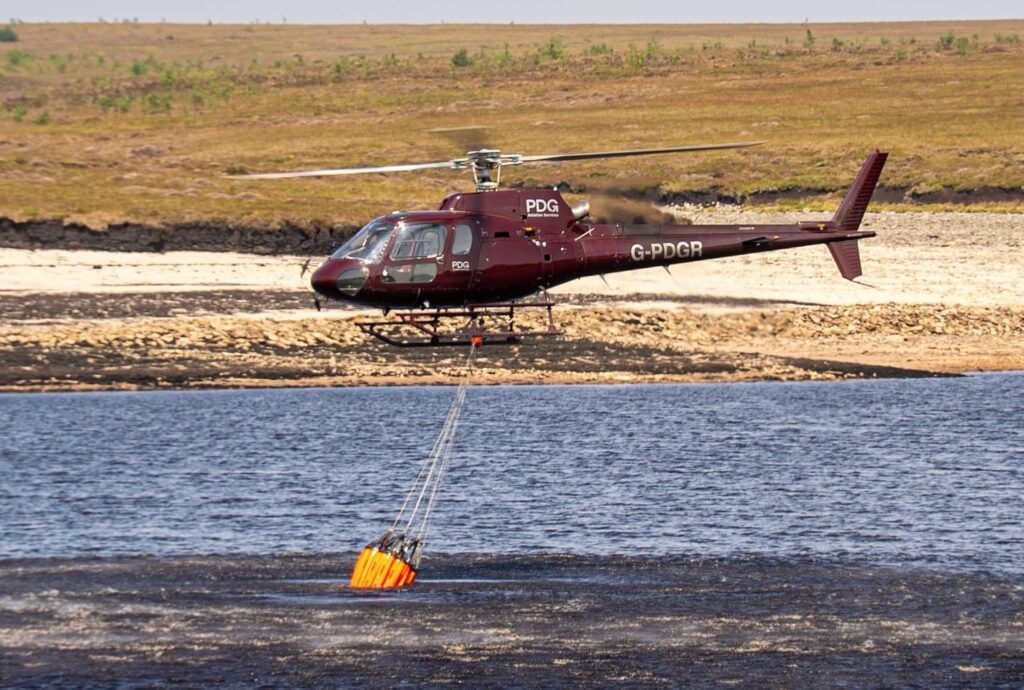
Britain already has commercial helicopter operators capable of fighting wildfires.
Companies such as Skyhook Helicopters and PDG Aviation Services can attach Bambi Buckets to suitable aircraft, collect water from a nearby loch, reservoir or lake and make repeated drops over the fire.
These helicopters aren’t a replacement for firefighters on the ground. A water drop may cool an area, slow the fire, protect crews or stop flames crossing a track or firebreak.
That can still make an enormous difference, particularly on steep ground or remote moorland where normal fire engines can’t get close.
The problem is that the UK only has a small pool of suitable commercial aircraft. Several large incidents at once can use up that capacity very quickly.
Recent BBC reporting on helicopter access in Scotland also raised questions about how aircraft are requested and paid for.
The Scottish Fire and Rescue Service doesn’t maintain its own firefighting helicopter fleet. On private land, the cost of commercial aircraft may fall to the landowner or an insurance company.
That creates the possibility of discussions about authorisation, necessity and insurance cover while the fire is still spreading.
This arrangement might make sense while a fire is small and entirely contained within private land. It becomes harder to defend once smoke is affecting nearby communities, roads are being closed and public fire services are committing crews for several days.
The same shortage became apparent during the July 2026 fires in Wales. North Wales Fire and Rescue Service said helicopter support had been requested, but aircraft were already committed to other fires elsewhere in Britain.
That seems to be the weakness in the present system. We have some capability, but we don’t necessarily have guaranteed availability when several areas need it at once.
Could public-service helicopters provide extra capacity?
The obvious question is whether the MOD and other public-service operators could provide additional aircraft when commercial helicopters are already committed.
This wouldn’t mean creating a new government firefighting fleet. Several aircraft already in service, used for military training, policing or on order have underslung-load capability.
A Bambi Bucket hangs from a helicopter’s cargo hook, so using one doesn’t require a substantial rebuild of the airframe. The equipment would still need to be approved, and pilots would need external-load and firefighting training, but the basic lifting capability is already there.
The military flying-training system uses 29 H135 Junos and seven H145 Jupiters at RAF Shawbury. These are contractor-supported training aircraft rather than front-line helicopters, so they couldn’t simply be diverted whenever a moorland fire starts.
Even so, they show how widespread the capability is.
The H135 can carry an external load of around 1,200kg, broadly equivalent to 1,200 litres of water before allowing for the weight of the bucket, fuel and operating conditions.
The larger H145 has a maximum cargo-hook load of 1,600kg, the equivalent weight of around 1,600 litres of water.
Its practical water load would normally be lower once the bucket and operating limits are taken into account, but a load of around 1,000 to 1,200 litres could still be useful when the aircraft is able to refill from a nearby reservoir, lake or loch.
The H145’s use for firefighting isn’t just theoretical.
German state police forces provide a useful comparison. More than 15 H145s were already serving with German police when further aircraft were ordered, with newer helicopters supplied with Bambi Buckets as part of their mission equipment. Bavarian police H145s have also been equipped for underslung loads and firefighting. Airbus describes the H145 as suitable for this combined police and emergency role.
There’s a public-service comparison closer to home as well.
The National Police Air Service operates 16 H135s and four H145s from bases across England and Wales, alongside four fixed-wing aircraft. New H135s are also being introduced as part of its fleet-renewal programme.
Police Scotland operates separately from NPAS. Its Air Support Unit uses a modern Airbus H135 T3 as its main helicopter along with an older H135 T2+ in backup, supplied and piloted under contract by Babcock.
None of these police helicopters currently forms a ready-made wildfire fleet. They’re configured and crewed for policing, and police work would remain their main responsibility. Adding a bucket capability would require approved equipment, trained pilots, contractual changes and arrangements for releasing aircraft from normal duties.
Even so, Germany shows that police H145s can combine law-enforcement work with an aerial-firefighting role. With H135s and H145s already distributed across England, Wales and Scotland, it seems reasonable to ask whether at least part of the police aviation fleet could be included in wider national contingency planning for the most serious wildfires.
The MOD has also bought six additional H145s for duties in Cyprus and Brunei. Defence Equipment and Support says the Cyprus aircraft will support emergency response and aerial firefighting.
That makes the lack of a similar arrangement at home look a little odd.
We already accept that wildfires around British overseas bases are predictable enough to justify equipment, training and aircraft availability. There doesn’t appear to be an equivalent standing capability for domestic fires.
The AW149 and Chinook
The incoming AW149 fleet could provide a larger option.
The government announced an order for 23 AW149 medium-lift helicopters in March 2026. The aircraft will be built at Yeovil as part of the New Medium Helicopter programme.
The AW149 can carry an external load of around 2,800kg, theoretically close to 2,800 litres of water before allowing for the bucket and operating conditions. Leonardo also lists Bambi Bucket compatibility among the aircraft’s possible equipment.
This doesn’t mean the new helicopters should spend their summers waiting for wildfires. Their main purpose is military transport and support.
But while a new fleet, training programme and support system are being introduced, it seems worth including a limited domestic firefighting role rather than trying to add it years later.
Chinook provides the much heavier option.
The RAF already uses Chinook for underslung loads, and the aircraft can lift more than ten tonnes in suitable conditions. That would be equivalent to more than 10,000 litres of water in simple weight terms, although operational firefighting buckets are normally smaller.
Chinooks used for wildfire work elsewhere have carried roughly 7,000 litres, which is probably a more useful comparison than quoting the aircraft’s absolute lifting limit.
More importantly, this isn’t a theoretical role for the RAF.
In May 2026, the RAF published details of Chinook crews training with Bambi Buckets in Cyprus. The same unit had supported the Cypriot authorities during the major wildfires of July 2025.
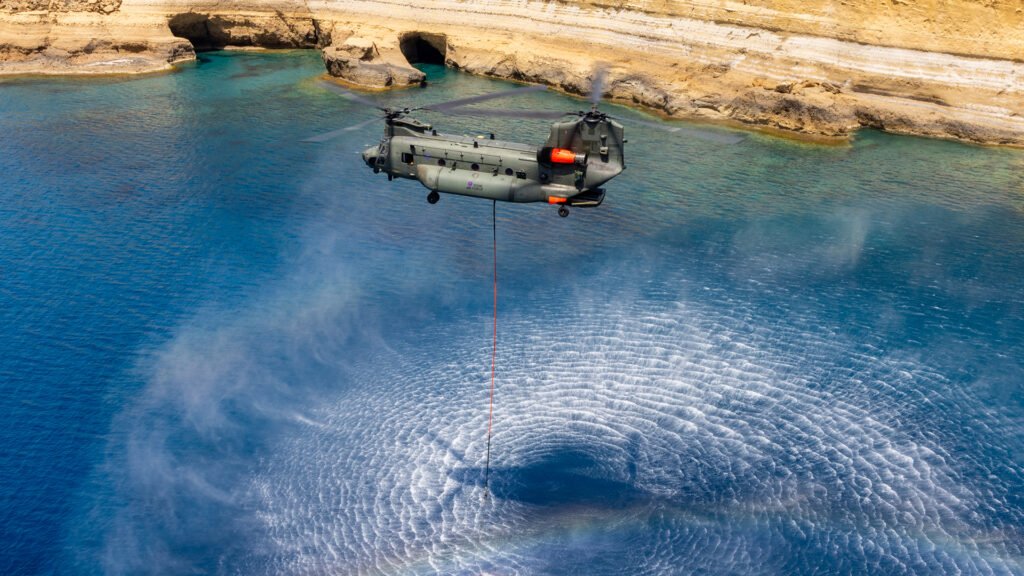
There’s far less evidence of MOD helicopters actually dropping water during wildfires in Britain.
Military personnel supported the response to the Saddleworth Moor fire in 2018, and the use of Chinooks with buckets was reportedly considered. Commercial aircraft carried out the water drops instead.
There may have been valid reasons for that. Aircraft availability, crew training, equipment location and other defence commitments all matter.
The point is that the underlying capability already exists. What seems to be missing is a domestic plan for using it.
That became particularly relevant on 25 July 2026, when the Scottish Government requested military aerial support for the Cairngorms wildfire.
The A400M is a much bigger step
Airbus has also developed a removable firefighting kit for the A400M Atlas, an aircraft already operated by the RAF.
The system can drop up to 20,000 litres of water or fire retardant without permanent modification to the aircraft.
It’s an interesting option, but it’s a considerable step up from buying buckets for helicopters that already carry underslung loads.
The RAF would need specialist crews, low-level operating procedures, suitable loading arrangements and an A400M available at the right time. Buying the kit wouldn’t automatically create a working water-bomber force.
It may be worth keeping under review, particularly if other A400M operators bring the system into service. Commercial helicopter contracts and a limited public-service bucket capability look like a more realistic starting point.
Other European countries plan for this nationally
Britain doesn’t face the same wildfire risk as Spain, France, Portugal, Italy or Greece. Direct comparisons need to be made carefully.
The difference is that those countries generally treat aerial firefighting as part of national emergency infrastructure.
France’s civil-protection organisation operates Canadair amphibious aircraft, Dash aircraft and helicopters.
Spain uses a mixture of national, regional and military aircraft. Other European countries maintain their own fleets or contract aircraft for the high-risk season.
There’s also a shared European reserve. For the 2026 wildfire season, the EU Civil Protection Mechanism placed 22 firefighting aeroplanes and five helicopters on standby across 12 participating countries.
Those aircraft can move between countries when national resources are overwhelmed. The EU is also developing a permanent rescEU firefighting fleet.
Britain could request international help during an extreme emergency, but that isn’t something we should rely on as our main plan.
The same hot and dry conditions affecting us may already be causing much larger fires in southern Europe. During a widespread heatwave, there may not be many spare aircraft available.
What would be a reasonable response?
I’m not convinced we need to buy a fleet of Canadairs and leave them sitting at an RAF base for much of the year.
There are more modest options.
The government could arrange national seasonal contracts with several commercial helicopter operators, guaranteeing that a minimum number of aircraft and crews remain available during periods of very high fire risk.
There could also be a central funding arrangement. Fire commanders shouldn’t have to wait while landowners, insurers and public agencies decide who’ll pay for a helicopter.
The MOD could keep a limited number of approved buckets in Britain and train a pool of crews to use them. Police aviation could also be considered as part of contingency planning, particularly where aircraft with suitable cargo-hook capability are already distributed around the country.
That wouldn’t mean police or military helicopters responding to every grass fire. They could provide additional capacity when commercial operators are already busy and several major incidents are burning at once.
The introduction of the AW149 gives the government a chance to include this in training and support arrangements from the start.
Prevention also needs to be taken more seriously.
That could include temporary restrictions on disposable barbecues and open fires during periods of extreme risk, improved firebreaks, better vegetation management, clearer access routes and more investment in early detection.
Fire and rescue services also need enough specialist vehicles, equipment and trained staff. The National Fire Chiefs Council’s wildfire position statement calls for better prevention, more consistent data, specialist training and stronger national coordination.
Aircraft aren’t a complete answer. They can’t replace firefighters, and they won’t compensate for poor land management.
But once a fire has escaped and is moving across steep or inaccessible ground, aircraft may be one of the few ways of slowing it quickly.
Is the current system still good enough?
Our present arrangements seem to be based on the assumption that major wildfires will remain fairly unusual and that commercial aircraft will usually be available when needed.
That assumption is looking less convincing.
We have experienced private helicopter operators, but only a limited number of aircraft. We have military helicopters capable of carrying water, but most of the MOD’s organised aerial-firefighting experience is overseas.
We also have police H135s and H145s spread across Britain, but no wider firefighting role comparable with that used by some German police forces.
Commercial support may still depend on a landowner, public agency or insurance company agreeing to pay.
None of this means we need to copy southern Europe or make a rushed purchase of specialist aircraft.
It does mean the government should explain what level of wildfire it’s preparing for, how quickly aerial support is expected to arrive and what happens when England, Scotland and Wales all need helicopters at the same time.
Perhaps the current mixture of private contractors, landowner arrangements and occasional public-sector assistance is considered sufficient.
After the fire seasons we’ve seen recently, I’m not sure that’s a particularly reassuring answer.
A little disclosure: there are affiliate links on this website! That just means if you click on a link, find something you like and buy it, this site might receive financial benefit. Don’t worry, you won’t pay any extra – sometimes you might even get a discount. These links help to pay for the upkeep of the site.
Disclaimer: The content of this website is opinion and should never be considered as professional advice. Always consult a professional in the relevant areas.